Selecting the right filtration media for refinery, chemical, and industrial process streams depends on understanding how operating conditions differ between standard applications and demanding petrochemical environments. While a standard industrial filter cartridge may suffice for water, light chemicals, or HVAC duty, a petrochemical filter cartridge is engineered to withstand higher temperatures, aggressive fluids, and continuous operation. This article compares the two categories across materials, construction, performance parameters, compliance requirements, and total cost of ownership, with reference to the product range and regional support available through Pullner Filter’s Jebel Ali Free Zone (JAFZA) office in Dubai.
What Is a Petrochemical Filter Cartridge?
A petrochemical filter cartridge is a replaceable filtration element designed to remove solid particulates from hydrocarbons, solvents, chemical process streams, condensate, and water in refinery, gas processing, and downstream chemical operations. It protects downstream equipment such as pumps, valves, heat exchangers, desalination reverse-osmosis membranes, and instrumentation from fouling and erosion.
Standard industrial filter cartridges are typically designed for lower temperatures, milder chemical environments, and shorter duty cycles. They are common in general manufacturing, commercial water treatment, food and beverage processing, and HVAC systems where operating parameters remain within a narrow, moderate band.
The fundamental difference is not one of size or shape alone — it is a difference in engineering intent. Petrochemical cartridges must maintain structural integrity and filtration efficiency when exposed to continuous heat, pressure surges, and chemically aggressive fluids that would quickly degrade standard media.
Key Differences Between Petrochemical and Standard Filter Cartridges
Temperature Tolerance
Petrochemical filter cartridges are rated for continuous service at elevated temperatures. Pullner’s PHFLH series, for example, is engineered for operation up to 120°C, while glass-fiber media variants can handle up to 121°C. Standard polypropylene cartridges are commonly limited to 40–82°C. Operating a standard cartridge above its thermal rating risks media degradation, bypass, and premature failure.
Pressure Capability
Reinforced construction is a hallmark of petrochemical-grade filters. Stainless steel SS304 or SS316L outer cages and center cores provide structural support under high differential pressures. The PHFLH series has a maximum differential pressure of 0.6 MPa (6 bar). Standard cartridges, which typically use polypropylene cores and cages, cannot sustain the same pressure loads without collapsing or deforming.
Chemical Compatibility
Media, support, seal, and gasket materials in petrochemical cartridges must resist hydrocarbons, aromatic solvents, acids, caustics, and steam. Available media include pleated polypropylene depth structures, resin-bonded glass fiber, polyethersulfone (PES), PTFE, nylon, PVDF, and high-temperature-resistant polyester. Seal materials range from nitrile rubber and EPDM to fluoro rubber (FKM/Viton) and silicone. Standard cartridges predominantly use commodity polypropylene media with limited chemical resistance, which can swell, soften, or dissolve when exposed to aggressive process fluids.
Flow Capacity and Geometry
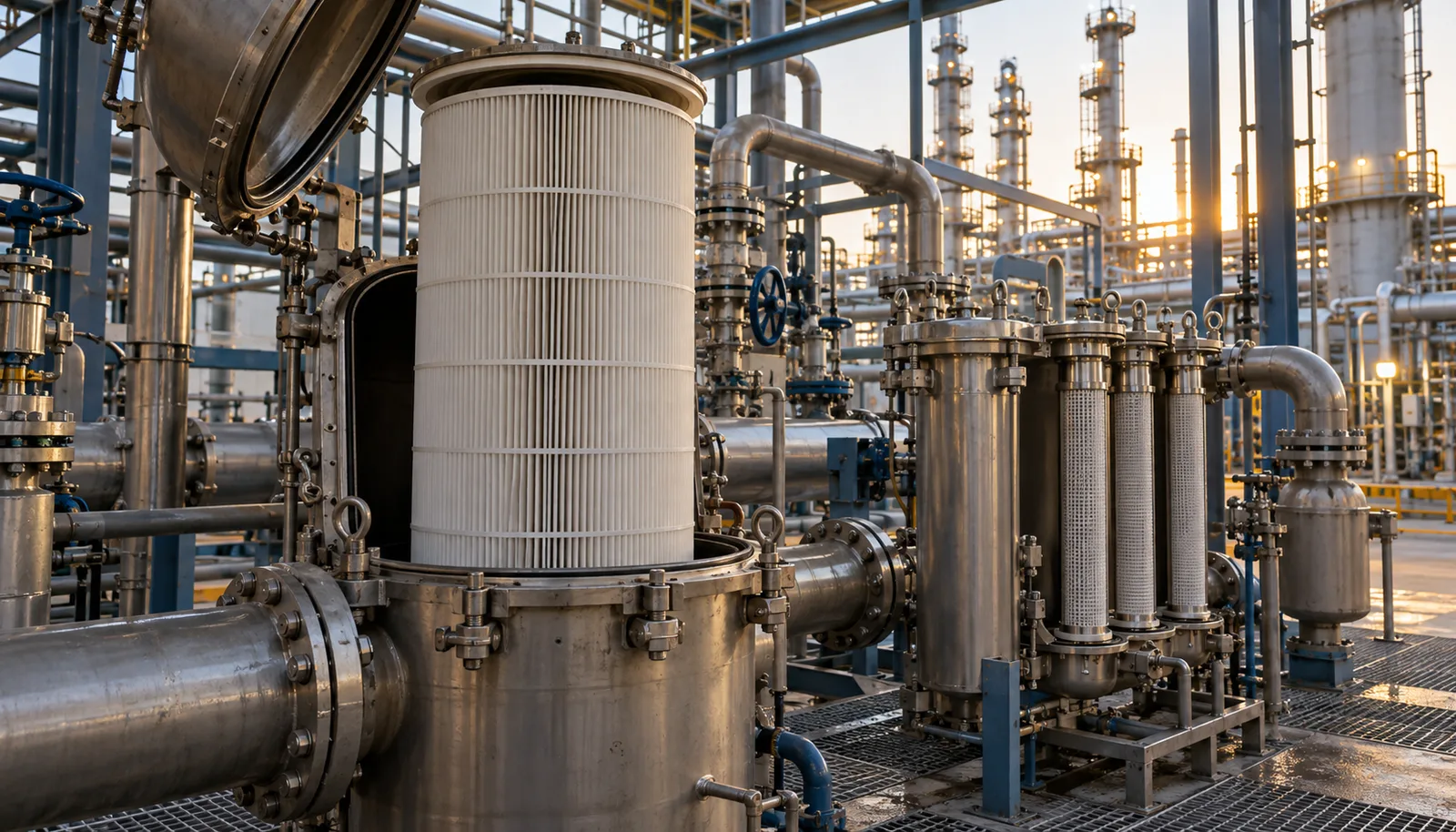
High-flow petrochemical cartridges use a 6-inch (152.4 mm) outer diameter with pleated design and outside-to-inside flow. A 40-inch cartridge can support 70 m³/h; a 60-inch cartridge supports 110 m³/h. Standard filter cartridges typically have smaller diameters and lower flow ratings, making them unsuitable for the volumetric demands of refinery and petrochemical processes.
High-flow pleated cartridge with stainless steel reinforcement and outside-to-inside flow path.
Construction Integrity
Petrochemical cartridges use thermal welding — heat-fused end caps — rather than adhesives. This eliminates media bypass, prevents delamination, and ensures compatibility with solvents and hydrocarbons that would attack bonding agents. Standard cartridges often rely on adhesive bonding, which can fail in chemically aggressive environments.
Service Life and Change-Out Intervals
Petrochemical cartridges are designed for longer intervals between change-outs, reducing unplanned downtime in continuous-duty refineries and power plants. Change-out is typically driven by differential pressure — for Pullner’s high-flow series, recommended change-out occurs at 1.5 bar and maximum at 2.5 bar at 20°C. Standard cartridges generally require more frequent replacement, increasing maintenance labor and consumables cost.
Materials and Construction
Filter Media Options
Petrochemical applications demand media that can tolerate high temperatures and aggressive fluids. Available options include pleated polypropylene depth structures, resin-bonded glass fiber and polyester, polyethersulfone, PTFE, nylon, PVDF, and high-temperature-resistant polyester. Each media type offers a specific profile of chemical resistance, thermal stability, and filtration efficiency.
Standard filters typically use melt-blown polypropylene depth media or simple pleated polypropylene without reinforcement. These materials are adequate for water, mild chemicals, and ambient-temperature service but lack the thermal and chemical resilience required for petrochemical streams.
Support and Hardware
Reinforcement materials in petrochemical cartridges include glass-fiber-reinforced polypropylene, polyester, and stainless steel 304 or 316L for cores and cages. End caps are made of polypropylene reinforced with glass fiber for pressure and temperature resistance. Standard cartridges use all-polypropylene construction throughout.
Sealing Technology
Thermal welding replaces adhesive bonding in petrochemical-grade cartridges. This ensures a leak-proof finish and eliminates the risk of chemical attack on bonding agents. Standard cartridges using adhesives may experience seal failure when exposed to hydrocarbons, leading to unfiltered bypass and downstream contamination.
Performance Under Harsh Conditions
Filtration Ratings
Petrochemical cartridges are available in ratings from 1 µm to 100 µm (PHFLH series), with membrane products covering 3 nm to 150 µm. High-flow pleated cartridges claim a 98% interception rate for impurity particles. Standard filters typically offer nominal ratings of 1–50 µm with lower efficiency claims.
Operating Limits Summary
| Parameter | Petrochemical Cartridge (Typical) | Standard Cartridge (Typical) |
|---|---|---|
| Max temperature | 120–121°C | 40–82°C |
| Max differential pressure | 0.6 MPa (6 bar) | 1.0–2.0 bar |
| Flow rate (40" cartridge) | 70 m³/h | 10–30 m³/h |
| Construction | SS304/SS316L reinforced | All-polypropylene |
| End-cap bonding | Thermal welded | Adhesive |
Testing and Verification
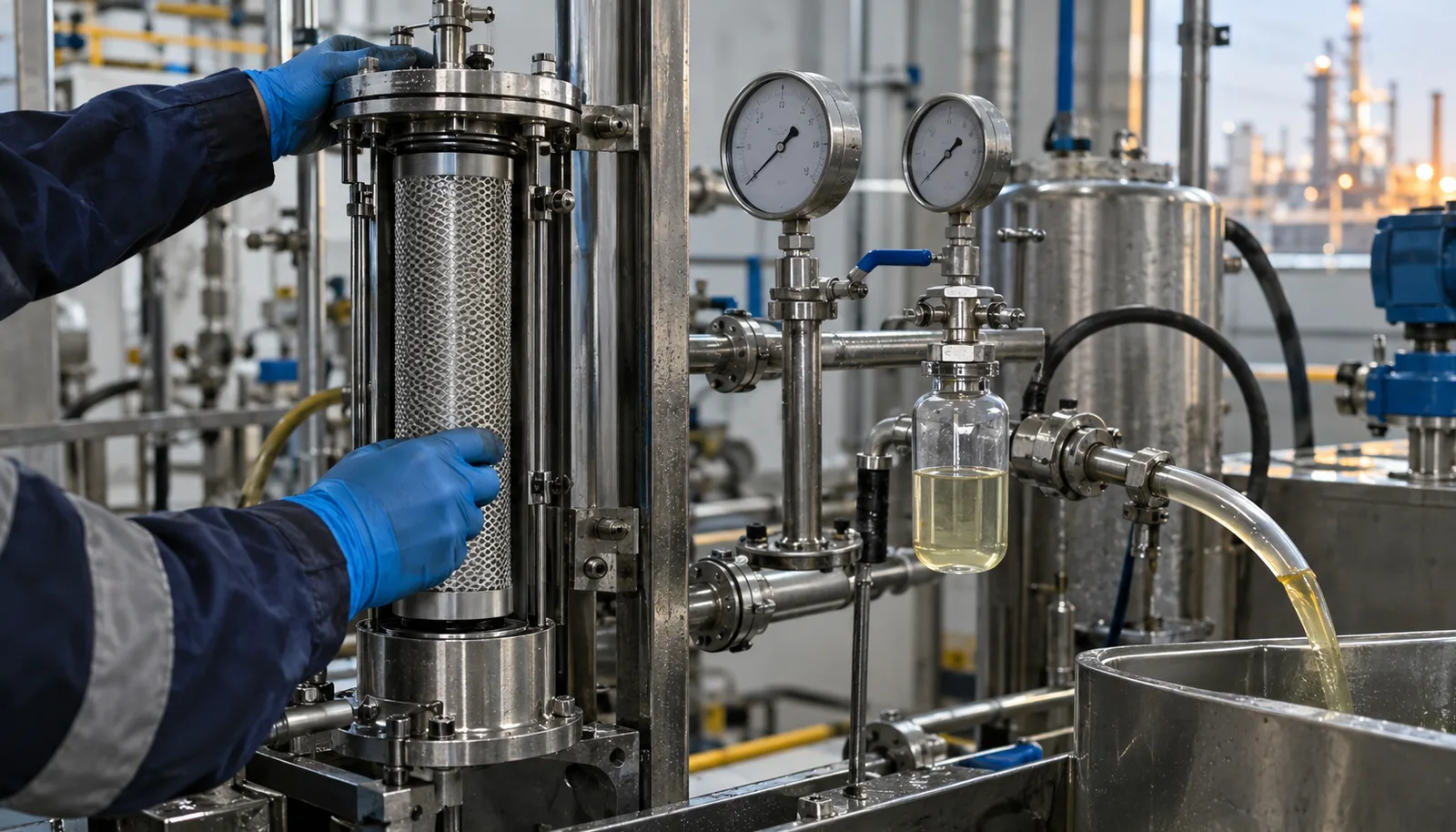
Pullner reports a testing infrastructure that includes equipment from TOPAS (Germany), IFTS (France), RION (Japan), PerkinElmer (USA), and PMI (USA). Verification methods include scanning electron microscopy for membrane structures and ion chromatography with ICP-MS for anion and cation precipitation testing. The company claims 100% factory testing with full-process batch-level traceability. Standard filter manufacturers may not offer the same level of documented quality assurance.
Compliance and Regional Requirements
UAE Regulatory Framework
Petrochemical filtration products distributed in the UAE must satisfy Emirates Conformity Assessment Scheme (ECAS) requirements. ECAS is a mandatory point-in-time conformity assessment for regulated products, valid for one year and requiring annual renewal. It demands test reports from ISO/IEC 17025-accredited laboratories, an Electronic Declaration of Conformity, and labels and user manuals in both Arabic and English.
The Emirates Quality Mark (EQM) is a voluntary premium mark involving factory audits and quality management system evaluation, valid for three years with ongoing surveillance. EQM can substitute for ECAS at customs and signals higher-tier manufacturing-system quality.
Suppliers to Abu Dhabi National Oil Company (ADNOC) must meet additional vendor registration requirements, including a mainland Abu Dhabi DED license with Supreme Petroleum Council approval, In-Country Value certification, and a SAP Ariba account. These compliance layers rarely apply to standard commercial filters and represent a significant differentiator for petrochemical-grade suppliers.
International Standards
Pullner reports certifications including ISO 9001 (quality management), ISO 14001 (environmental management), ISO 45001 (occupational health and safety), ASME U-Stamp (pressure vessel components), SGS accreditation, CE, and UL. These certifications are claimed in first-party materials and should be verified through the relevant certification bodies by prospective buyers.
For more detail on UAE conformity requirements, refer to the Ministry of Industry and Advanced Technology official site. For quality management system standards, ISO 9001 provides the international framework.
Choosing the Right Filter for Your Application
Select between a petrochemical filter cartridge and a standard filter based on these criteria:
- Operating temperature: If your process fluid exceeds 80°C, a petrochemical-grade cartridge is required.
- Chemical environment: Hydrocarbons, solvents, acids, and caustics demand media and seal materials that standard cartridges cannot provide.
- Pressure conditions: Systems with differential pressure above 3 bar or with frequent pressure surges need reinforced construction.
- Flow requirements: High-volume processes benefit from 6-inch large-diameter pleated designs that standard cartridges cannot match.
- Compliance obligations: Supplying to national oil companies or regulated UAE industries requires ECAS, EQM, or ADNOC registration that standard filter suppliers may not hold.
- Downtime cost: In continuous-duty refineries and power plants, longer cartridge life and tool-less changeovers reduce unplanned downtime and total operating cost.
Condensate polishing filtration skid in a refinery or power plant application.
Pullner Filter’s JAFZA office at LB19-Office No.1207 in the Jebel Ali Free Zone, Dubai, serves as a regional sales, technical support, and distribution hub for Middle Eastern petrochemical clients. The office coordinates with the company’s manufacturing and R&D base in Shanghai, which produces pleated, depth, and membrane filter cartridges across multiple production lines. The location adjacent to Jebel Ali Port — the world’s largest man-made port — and near Al Maktoum International Airport enables efficient regional and global distribution.
Final Recommendation
For applications involving high temperatures, aggressive chemicals, high flow rates, or compliance with UAE and national oil company standards, a petrochemical filter cartridge is the correct choice. Standard filters remain appropriate for general industrial water, light chemical, and HVAC service where operating parameters are moderate and regulatory requirements are minimal.
When specifying a petrochemical filter cartridge, verify that the supplier’s construction methods, media options, seal materials, and certification documentation align with your process conditions and regulatory obligations. Pullner Filter’s product range — including the PHFLH high-temperature series, PHFK high-flow series, and membrane cartridges — provides options for most refinery, chemical, and power generation applications, with regional support available through the JAFZA office.
The most cost-effective filtration strategy is not necessarily the cheapest cartridge, but the one that matches your operating envelope, minimizes unplanned downtime, and satisfies your compliance requirements. Investing in a properly specified petrochemical filter cartridge reduces total cost of ownership through longer service life, lower energy consumption from reduced pressure drop, and fewer maintenance interventions.